Tại bài viết này, các bạn hãy cùng IELTS CITY giải đề IELTS Reading – What Are the 1,000 Foods to Eat Before You Die? kèm phân tích chi tiết nhé!
Bài đọc
What Are the 1,000 Foods to Eat Before You Die?
Written by a former New York Times restaurant critic, this tome will keep your appetite satisfied for a lifetime.
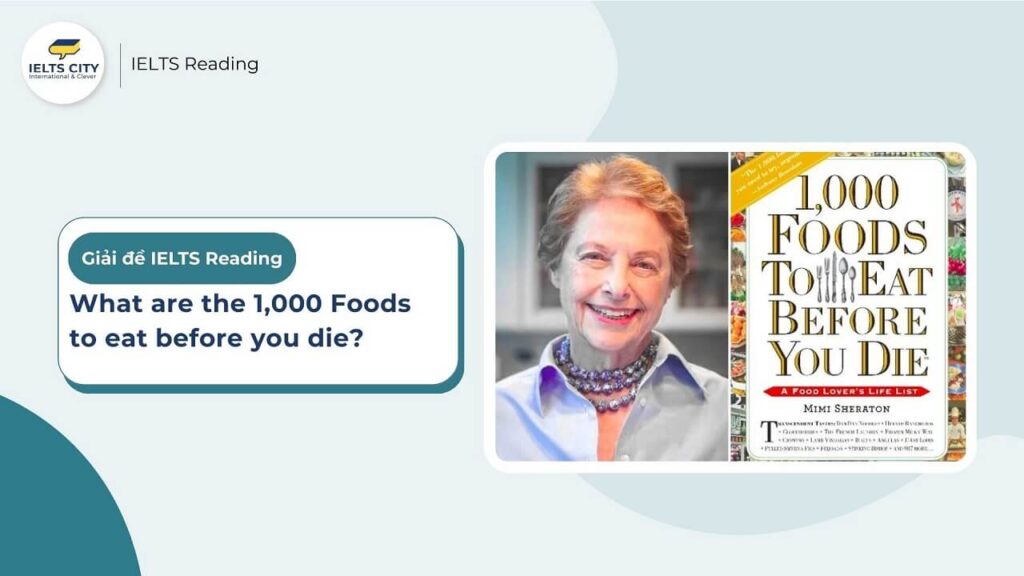
When was the last time you sat down to a meal of harnam meshwi, a.k.a. grilled pigeon, which is most likely found on a menu in Egypt? Or traveled to Oslo, Norway, for a breakfast of freshly caught shrimp? Chances are probably never. However, thanks to former New York Times restaurant critic, Smithsonian contribution and author Mimi Sheraton’s latest book, 1,000 Foods to Eat Before You Die, your foodie life is about to get a whole lot more interesting.
Inspired by Patricia Schultz’s best-selling 1,000 Places to See Before You Die (also published by Workman Publishing), Sheraton has rounded up 1,000 must-try dishes, restaurants, markets, cultural feasts, and even some relatively universal foods (such as bananas, olive oil, and whipped cream) that transcend regional categorization. Curated from cuisines around the globe, Sheraton has put them together in one large volume, along with details on historic and cultural context, tips on how to prepare or where to try a particular dish, and even several dozen recipes. It’s a project that’s been 10 years in the making—one that’s as much a wonderful display of Sheraton’s vast food knowledge (she’s been writing about food for 60 years) as it is an ode to the world’s sheer culinary diversity.
The ultimate gift for the food lover. In the same way that 1,000 Places to See Before You Die reinvented the travel book, 1,000 Foods to Eat Before You Die is a joyous, informative, dazzling, mouthwatering life list of the world’s best food. The book is organized not by country or type of food, but rather by the experience of eating itself. Sections guide the reader through “Street Food & Snacks,” “Comfort Food,” and “Sweets & Treats,” among others. This structure encourages serendipitous discovery, where a reader looking for a classic French pastry might stumble upon a traditional Indonesian dessert and become captivated. Sheraton’s entries are more than just lists; they are miniature stories. She explains why a specific cheese from a remote village in Greece is worth seeking out, or how a particular noodle dish embodies the history of trade routes in Southeast Asia. This narrative approach transforms the book from a mere checklist into a compelling read about culture, history, and human connection through food.
Of course, a list of 1,000 items is bound to include some controversies. Some critics question the inclusion of ubiquitous items like the banana, arguing that it diminishes the exclusivity of the list. Others have noted a possible bias towards European and North American cuisines, though Sheraton defends her selections by pointing to the extensive research and personal travels that informed her choices. She emphasizes that the book is a personal, albeit expert, guide rather than a definitive, objective ranking. The goal, she states, is to inspire curiosity and appreciation, not to end debate.
Ultimately, 1,000 Foods to Eat Before You Die serves as a passport to gastronomic adventure. It challenges the reader to look beyond their culinary comfort zone, whether that means seeking out a rare ingredient, attempting a complex recipe at home, or simply ordering something unfamiliar at a local restaurant. For Sheraton, the book is a culmination of a lifetime’s passion for food, an invitation to savor the incredible diversity of flavors the world has to offer, one unforgettable bite at a time.
Kiến thức cần nắm:
Câu hỏi
Questions 27-31
Do the following statements agree with the information given in Reading Passage 3?
In boxes 27-31 on your answer sheet, write
TRUE – if the statement agrees with the information
FALSE – if the statement contradicts the information
NOT GIVEN – if there is no information on this
- 27. Mimi Sheraton is currently working as a restaurant critic for the New York Times.
- 28. The book 1,000 Foods to Eat Before You Die was directly inspired by a popular travel guide.
- 29. Sheraton’s book includes recipes for every one of the 1,000 foods mentioned.
- 30. The book is organized according to the geographic origin of the foods.
- 31. Sheraton has been a food writer for six decades.
Questions 32 – 35
Choose the correct letter, A, B, C or D.
Write the correct letter in boxes 32-35 on your answer sheet.
32. The main purpose of the first paragraph is to
- A. criticize people’s boring eating habits.
- B. provide specific examples of exotic foods.
- C. explain the health benefits of a global diet.
- D. introduce the book by highlighting its adventurous nature.
33. According to the passage, the book includes all of the following EXCEPT
- A. historical background for certain dishes.
- B. recommendations on where to find specific foods.
- C. nutritional information for each food item.
- D. a small number of full recipes.
34. How is the book’s structure described?
- A. It is organized by country to make it easy for travelers.
- B. It categorizes foods by their main ingredient.
- C. It groups foods by the type of eating experience.
- D. It is presented in a simple alphabetical list.
35. What is the author’s stated goal for the book?
- A. To create an objective and definitive ranking of world foods.
- B. To settle debates about the best cuisines.
- C. To inspire curiosity and appreciation for diverse foods.
- D. To promote European and North American restaurants.
Questions 36 – 40
Complete the summary below.
Choose NO MORE THAN TWO WORDS from the passage for each answer.
Write your answers in boxes 36-40 on your answer sheet.
Mimi Sheraton’s book has been described as a 36._____ for anyone who loves food. It is noted for its narrative approach, where each entry is like a mini 37._____ , explaining the cultural significance of a dish. While the book has faced some 38._____ , particularly over the inclusion of common items and a potential regional bias, Sheraton clarifies that the selections are based on her own 39._____ and expert opinion. The ultimate aim of the book is to encourage readers to expand their 40._____ and embark on a gastronomic adventure.
Đáp án kèm phân tích
Questions 27-31: TRUE / FALSE / NOT GIVEN
27. FALSE
- Giải thích: Bài đọc mô tả Mimi Sheraton là “cựu” nhà phê bình của tờ New York Times. Câu hỏi nói cô ấy “hiện tại” (currently) đang làm việc ở đó là sai.
- Vị trí: Đoạn 1: “Written by a former New York Times restaurant critic…”.
28. TRUE
- Giải thích: Tác giả khẳng định cuốn sách được lấy cảm hứng trực tiếp từ cuốn cẩm nang du lịch nổi tiếng của Patricia Schultz.
- Vị trí: Đoạn 2: “Inspired by Patricia Schultz’s best-selling 1,000 Places to See Before You Die…”.
29. FALSE
- Giải thích: Cuốn sách chỉ bao gồm “vài tá” (khoảng vài chục) công thức nấu ăn, không phải cho tất cả 1.000 món.
- Vị trí: Đoạn 2: “…and even several dozen recipes.”.
30. FALSE
- Giải thích: Cấu trúc cuốn sách không dựa trên địa lý (quốc gia) mà dựa trên trải nghiệm ăn uống.
- Vị trí: Đoạn 3: “The book is organized not by country or type of food, but rather by the experience of eating itself.”.
31. TRUE
- Giải thích: Bài đọc xác nhận Sheraton đã viết về ẩm thực được 60 năm, tương ứng với 6 thập kỷ.
- Vị trí: Đoạn 2: “…(she’s been writing about food for 60 years)…”.
Questions 32 – 35: Multiple Choice
32. D
- Giải thích: Đoạn đầu liệt kê các món ăn lạ và trải nghiệm du lịch ẩm thực để giới thiệu cuốn sách như một hành trình phiêu lưu đầy thú vị.
- Vị trí: Đoạn 1: “…travel to Oslo… for a breakfast of freshly caught shrimp?… your foodie life is about to get a whole lot more interesting.”.
33. C
- Giải thích: Bài đọc nhắc đến bối cảnh lịch sử, địa điểm ăn thử và một số công thức, nhưng hoàn toàn không đề cập đến thông tin dinh dưỡng (nutritional information).
- Vị trí: Đoạn 2: “…details on historic and cultural context (A), tips on how to prepare or where to try (B)… even several dozen recipes (D).”.
34. C
- Giải thích: Cuốn sách được chia thành các phần dựa trên loại trải nghiệm như “Đồ ăn đường phố”, “Đồ ăn an ủi”.
- Vị trí: Đoạn 3: “Sections guide the reader through “Street Food & Snacks,” “Comfort Food,” and “Sweets & Treats,”…”.
35. C
- Giải thích: Mục tiêu chính của Sheraton là khơi gợi sự tò mò và lòng trân trọng đối với sự đa dạng ẩm thực.
- Vị trí: Đoạn 4: “The goal, she states, is to inspire curiosity and appreciation…”.
Questions 36 – 40: Summary Completion
36. gift
- Giải thích: Cuốn sách được coi là món quà tuyệt vời nhất cho những người yêu ẩm thực.
- Vị trí: Đoạn 3: “The ultimate gift for the food lover.”.
37. stories
- Giải thích: Cách tiếp cận của Sheraton biến mỗi mục thành một câu chuyện nhỏ kể về văn hóa và lịch sử.
- Vị trí: Đoạn 3: “Sheraton’s entries are more than just lists; they are miniature stories.”.
38. controversies
- Giải thích: Một danh sách lớn 1.000 món chắc chắn sẽ vấp phải một số tranh cãi về việc lựa chọn món.
- Vị trí: Đoạn 4: “…a list of 1,000 items is bound to include some controversies.”.
39. research
- Giải thích: Sheraton bảo vệ lựa chọn của mình bằng cách chỉ ra những nghiên cứu sâu rộng và các chuyến du lịch cá nhân của cô.
- Vị trí: Đoạn 4: “…Sheraton defends her selections by pointing to the extensive research and personal travels…”.
40. comfort zone
- Giải thích: Cuốn sách thách thức người đọc vượt ra khỏi “vùng an toàn” ẩm thực của chính mình để thử điều mới.
- Vị trí: Đoạn 5: “It challenges the reader to look beyond their culinary comfort zone…”.
Cảm ơn các bạn đã theo dõi hết bộ đáp án của đề IELTS Reading – What Are the 1,000 Foods to Eat Before You Die? kèm phân tích chi tiết của IELTS CITY. Chúc các bạn luyện thi IELTS Reading hiệu quả và sớm đạt Target nhé!
Cập nhật đề thi thật sớm nhất tại: