Tại bài viết này, IELTS CITY sẽ cùng các bạn giải đề IELTS Reading – The Origin of Paper kèm phân tích chi tiết sau đây nhé!
Bài đọc
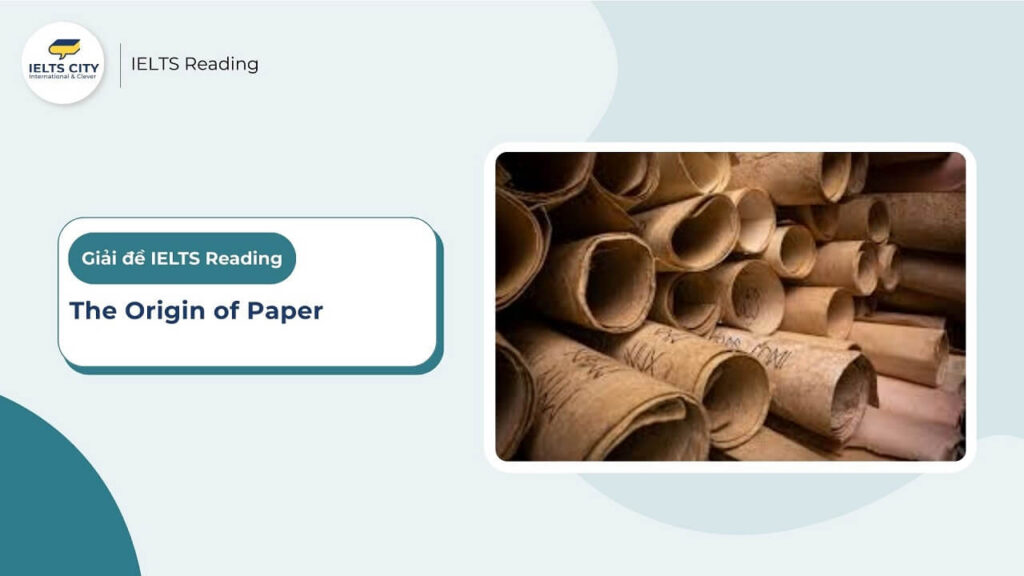
The Origin of Paper
The word paper derives from the Greek term for the ancient Egyptian writing material called papyrus. In about 2400 BC, the Egyptians discovered how to make a writing surface out of papyrus, a type of reed that grows along waterways in southern Europe and North Africa. The Egyptians cut the plant into strips which they softened in water. Papyrus was cross-woven into a mat and then pounded into a hard thin sheet. As the papyrus plant requires subtropical conditions to grow, papyrus was not much used in Europe at that time; instead, the main material used for writing was parchment. This was made from animal skin and was extremely expensive. In fact, it has been estimated that a single book written on parchment required the skins of 300 sheep. The skins had to be specifically prepared by drying them and they were then stretched on a special frame. It is not known when parchment was first introduced, but it was the main writing material in Europe for hundreds of years.
Paper, which is made from pulp, rags, and fibers of plants, seems to have been invented in China and is considered to be one of the Four Great Inventions of Ancient China. In 105 AD, under the Han Dynasty emperor Ho-Ti, a government official in China named Ts’ai Lun was the first to start a papermaking industry. Ts’ai Lun seems to have made his paper by mixing finely chopped mulberry bark and hemp rags with water, mashing the mixture flat with a stone mortar, and then pressing out the water and letting it dry in the sun. He may have based his idea on bark cloth, which was very common in China and also made from mulberry.
Previously, during the Shang (1600-1050 BC) and Zhou (1050-256 BC) dynasties of Ancient China, documents were ordinarily written on bone or bamboo (on tablets or on bamboo strips sewn and rolled together into scrolls), making them very heavy and awkward to transport. The light material of silk was sometimes used, but was normally too expensive to consider. When it was first invented, paper was used for purposes of wrapping or padding protection for delicate bronze mirrors. Although paper used for writing became popular by the 3rd century AD, it continued to be used for wrapping and other purposes. During the Tang Dynasty (618-907 AD) paper was folded and sewn into square bags to preserve the flavor of tea. During the same period, according to a written account, tea was served from baskets with multi-colored paper cups and paper napkins of different sizes and shapes. During the Chinese Song Dynasty (960-1279 AD) not only did the government produce the world’s first known printed paper money, or banknote, but paper money bestowed as gifts was wrapped in special paper envelopes.
Paper spread slowly outside of China; other Asian cultures, even after seeing paper, could not make it themselves. Instruction in the manufacturing process was required, and the Chinese were reluctant to share their secrets. It made its true push westward in 751 AD when the Tang Dynasty was at war with the Islamic world. During a battle on the banks of the Tarus river, a Chinese caravan was captured which happened to include several papermakers. They were taken away to Samarkand, which was a good place to make paper because it had an abundant supply of hemp and flax.
Samarkanders changed the technology of manufacturing paper. They began to prepare it in stone mills and Samarkand became an important papermaking center. The rudimentary and laborious process of papermaking was refined and bulk manufacturing of paper began in Iran, where they invented a method to make a thicker sheet of paper, which helped transform papermaking from an art into an important business. Gradually papermakers made their way further west through the Arab world – to Baghdad, Damascus and Cairo. Finally, when the Moors from North Africa invaded Spain and Portugal they brought the technology with them and so it was that papermaking entered Europe in the 12th century.
In Europe, the preferred medium for the artists and literati of the time was still the smooth and lustrous parchment. The notion of paper being used as a practical everyday item did not occur until the 15th century when Johannes Gutenberg perfected movable type printing, which included the use of metal molds and alloys, a special press, and oil-based inks, allowing the mass production of printed books. The birth of the modern paper and printing industry is commonly marked from this date. Printing technology rapidly developed and created an ever-increasing demand for paper. The early European papers were made from recycled cotton and linen – and a huge trade quickly developed around the trading of old rags. It is said that the disease known as ‘the Black Death’ entered England from Europe on these old rags. Yet soon this source became insufficient and some curious attempts were made to find new materials. Experiments with fibers such as straw, cabbage, wasp nests and finally wood, resulted in inexpensive – and replaceable – materials for papermaking. Today, the long soft fibers of softwoods such as spruce have become the most suitable source of pulp for the mass production of paper.
Kiến thức cần nắm:
Câu hỏi
Questions 1 – 7
Do the following statements agree with the information given in Reading Passage 1? In boxes 1-7 on your answer sheet, write
- TRUE if the statement agrees with the information
- FALSE if the statement contradicts the information
- NOT GIVEN if there is no information on this
1. ln Ancient China, writing was occasionally done on silk.
2. Coloured paper was invented during the Tang Dynasty.
3. Papermakers from Samarkand were captured by the Chinese.
4. Papermaking as a large-scale industry originated in Iran.
5.Papermaking skills were brought to Europe via North Africa.
6. When Gutenberg invented movable type, paper materials were very expensive.
7. The end of the trade in rags was brought about by the difficulty of transporting them.
Questions 8 – 13
Complete the table below.
Choose ONE WORD ONLY from the passage for each answer.
Write your answers in boxes 8 – 13 on your answer sheet.
The development of paper
| Place | Date of introduction | Materials used | Method of production |
|---|---|---|---|
| Egypt | about 2400 BC | a plant called papyrus | 8………….. of the plant were softened in water, woven and pounded |
| Europe | unknown | parchment made from the skin of animals such as 9…….. | skin was dried and 10……….. |
| China | 105AD | 11…………. of a mulberry tree and hemp rags | ingredients were mixed with water, pressed and put outside in the sun |
| 12……….. | 751AD | flax and hemp | mills made of 13………. were used |
Đáp án kèm phân tích
Questions 1 – 7: TRUE / FALSE / NOT GIVEN
1. TRUE
- Giải thích: Bài đọc xác nhận lụa đôi khi được sử dụng để viết dù nó rất đắt. “Sometimes used” tương ứng với “occasionally done”.
- Vị trí: Đoạn 3: “The light material of silk was sometimes used, but was normally too expensive to consider.”
2. TRUE
- Giải thích: Trong thời kỳ nhà Đường, có các ghi chép về việc sử dụng các cốc giấy nhiều màu (multi-colored paper cups), điều này xác nhận sự tồn tại của giấy màu trong giai đoạn này.
- Vị trí: Đoạn 3: “During the Tang Dynasty… tea was served from baskets with multi-colored paper cups…”
3. FALSE
- Giải thích: Thông tin bị ngược. Thực tế là một đoàn lữ hành Trung Quốc (bao gồm các thợ làm giấy) đã bị phía Hồi giáo bắt giữ và đưa đến Samarkand. Câu hỏi nói thợ làm giấy từ Samarkand bị Trung Quốc bắt là sai.
- Vị trí: Đoạn 4: “…a Chinese caravan was captured which happened to include several papermakers. They were taken away to Samarkand…”
4. TRUE
- Giải thích: Bài đọc nêu rõ việc sản xuất giấy hàng loạt (bulk manufacturing) bắt đầu ở Iran, biến nghề này từ một môn nghệ thuật thành một ngành kinh doanh quan trọng.
- Vị trí: Đoạn 5: “…bulk manufacturing of paper began in Iran, where they invented a method… transform papermaking from an art into an important business.”
5. TRUE
- Giải thích: Công nghệ làm giấy vào Châu Âu thông qua các hiệp sĩ Moors từ Bắc Phi khi họ xâm lược Tây Ban Nha và Bồ Đào Nha.
- Vị trí: Đoạn 5: “Finally, when the Moors from North Africa invaded Spain and Portugal they brought the technology with them… papermaking entered Europe…”
6. NOT GIVEN
- Giải thích: Bài đọc có nhắc đến việc Gutenberg hoàn thiện in ấn cho phép sản xuất sách hàng loạt, nhưng không cung cấp thông tin cụ thể về việc liệu vật liệu giấy lúc đó có “rất đắt” hay không.
- Vị trí: Đoạn 6.
7. FALSE
- Giải thích: Việc buôn bán giẻ rách (nguyên liệu làm giấy cũ) kết thúc vì nguồn cung này trở nên “không đủ” (insufficient), chứ không phải do khó khăn trong vận chuyển.
- Vị trí: Đoạn 6: “Yet soon this source became insufficient and some curious attempts were made to find new materials.”
Questions 8 – 13: Table Completion
8. strips
- Giải thích: Người Ai Cập cắt cây papyrus thành các dải (strips) để xử lý.
- Vị trí: Đoạn 1: “The Egyptians cut the plant into strips which they softened in water.”
9. sheep
- Giải thích: Da cừu là nguyên liệu phổ biến để làm giấy da (parchment) tại Châu Âu.
- Vị trí: Đoạn 1: “…a single book written on parchment required the skins of 300 sheep.”
10. stretched
- Giải thích: Da động vật sau khi sấy khô sẽ được căng trên một khung đặc biệt.
- Vị trí: Đoạn 1: “…drying them and they were then stretched on a special frame.”
11. bark
- Giải thích: Ts’ai Lun đã sử dụng vỏ cây (bark) của cây dâu tằm để làm giấy.
- Vị trí: Đoạn 2: “…mixing finely chopped mulberry bark and hemp rags with water…”
12. Samarkand
- Giải thích: Năm 751 sau CN, Samarkand trở thành một trung tâm làm giấy quan trọng sau khi các thợ làm giấy Trung Quốc bị đưa đến đây.
- Vị trí: Đoạn 4 & 5: “…taken away to Samarkand… became an important papermaking center.”
13. stone
- Giải thích: Tại Samarkand, họ đã thay đổi công nghệ bằng cách sử dụng các cối xay bằng đá.
- Vị trí: Đoạn 5: “They began to prepare it in stone mills…”
Cập nhật đề thi thật sớm nhất tại: