Tại bài viết này, IELTS CITY sẽ cùng các bạn giải đề IELTS Reading – Sorry who are you? kèm phân tích chi tiết nhé!
Bài đọc
Sorry – Who Are You?
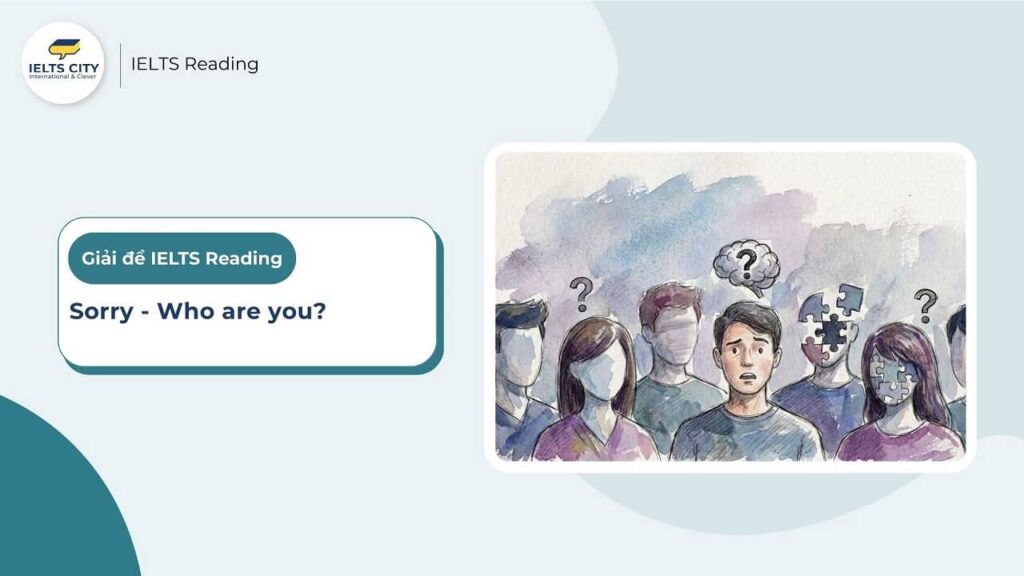
Prosopagnosia is a medical condition that stops people from recognizing faces. But how common is it and why does it happen?
It was Jacob Hodes’ first day at college. He can still recall spending an enjoyable afternoon being shown around campus by a second-year student named Daniel Byrne, who happened to be from his hometown. Jacob then spent the rest of the year ignoring him. “I never saw him again,” he says. “Well, I’m sure I walked past him plenty of times, but I just didn’t see him.” This behavior wasn’t intentional. Jacob just couldn’t recollect what his fellow student looked like. He had had the same trouble all his life. Friends and relatives would greet him, and he would have no idea who they were.
It wasn’t until five years ago that it all made sense. That was when Hodes was diagnosed with prosopagnosia, a condition that means he is unable to recognize faces. According to researchers, he is far from alone. In fact, the condition is not that uncommon, but until a few years ago, only a few dozen cases had ever been described, and all of these had been caused by brain injury. Recently, though, researchers identified a second form of face blindness – developmental prosopagnosia, which is either present from birth or develops very early in life.
In May, a team from Harvard University in the US and University College London (UCL) announced the results of a web survey of 1,600 people, suggesting that up to 2 percent of people have some degree of face blindness. Then in August, Martina Gruter and colleagues at the Institute for Human Genetics in Münster, Germany, similarly reported that 2.5 percent of 700 secondary school pupils they had tested had trouble recognizing faces. The results of the survey took everyone by surprise.
It seems that if you have never known what it is to recognize a face, you don’t necessarily know that you are supposed to be able to. “Prosopagnosics almost always know that they have trouble recognizing people, but they often don’t realize that other people have better recognition skills than they do,” says Brad Duchaine, a researcher at UCL.
Despite these issues, the majority of developmental prosopagnosics possess strategies that allow them to get around their difficulty. For instance, they recognize hair, clothing, or a person’s way of speaking. So, unless they see a familiar person out of context, with a new hairstyle or in different clothes, they can recognize people just fine. Even so, the discovery of developmental prosopagnosia has attracted attention from neuroscientists keen to discover what is different about the brain of face-blind people. This difference, they believe, could help solve the problem of how the brain deals with information in general – not just visual data. In other words, it may show whether the brain has specialized parts for specific tasks or is more of a general-purpose information processor.
One issue, however, that will present challenges for researchers is that no two prosopagnosics are the same. Some have problems only with faces, while others have trouble with ordinary everyday objects and, so it turns out, animals, which would normally be familiar as well. Some prosopagnosics can train themselves to recognize specific faces; others can’t even recognize their own in a mirror. When some have been tested, they could identify the emotion conveyed on another’s face, even though the face itself seemed unfamiliar, while for other subjects, this was an impossibility. Some cannot recognize the faces of old friends or fellow students but have no trouble telling whether a particular face from such groups would be attractive to most people. Because of this diversity, working out the cause of prosopagnosia will not be easy.
In Martina Gruter’s study, the prosopagnosics who agreed to have their parents and relatives tested reported at least one with the condition. Having looked at 38 cases in seven families, the German team believes they have good evidence that a single gene could be responsible. Duchaine also has some evidence that face blindness could be inherited but thinks other factors might be more significant. He refers to studies of babies born with a condition that means the eye’s lens is not clear, and when it’s the left one, being unable to see through this eye during the first two months of life is a major risk factor for prosopagnosia.
Whatever the cause, what most prosopagnosics want to know is whether they can do anything to improve their face recognition skills. Joseph Degutis, a graduate student at the University of California, recently reported successfully training a severe developmental prosopagnosic to recognize faces during tests carried out in the laboratory. The subject also reported that recognizing faces in everyday life became easier due to the training. Duchaine now plans to attempt to train sufferers to recognize the five people that they most need to know – maybe their immediate family, for example, and essential colleagues.
However, Martina Gruter’s husband, who also works on her team, is not convinced it will work. “I don’t know how you can have more training than you have already had,” he says. “Humans already spend all day looking at faces.” He also points out that cheating is a possibility during tests and provides an example: one person they studied said that when she was doing the face-recognition test, she memorized the distance between the nose and upper lip. She wasn’t the only one. “So, you can perform well in the test and not do so well in real life.”
Kiến thức cần nắm:
Câu hỏi
Questions 1 – 7
Do the following statements agree with the information given in Reading Passage 1?
In boxes 1-7 on your answer sheet, write:
TRUE – if the statement agrees with the information
FALSE – if the statement contradicts the information
NOT GIVEN – if there is no information on this
1. Before attending college, Jacob was capable of recognizing people he knew well.
2. Researchers believe that prosopagnosia may be a growing problem.
3. It is harder to identify developmental prosopagnosia in babies than in young children.
4. A German study seems to support the Harvard and UCL research findings.
5. In general, prosopagnosics are aware that other people can recognize faces more easily than they can.
6. In most cases, prosopagnosics have developed ways to deal with their problem.
7. The study of prosopagnosia may help neuroscientists to treat different kinds of brain injury.
Questions 8 – 13
Complete the notes below.
Choose ONE WORD ONLY from the passage for each answer.
Write your answer in boxes 8-13 on your answer sheet.
Differences in prosopagnosis
The challenges for prosopagnosia researchers
As well as being unable to recognize facial features, prosopagnosics may also have problems recognizing commonly seen 8.________
The 9.________ and objects on someone else’s face.
Some prosopagnosics can recognize that people are regarded as attractive by others.
Causes of prosopagnosia
Prosopagnosia may be caused by
just one 10.________ according to Martina Gruter
a defect in the 11.________ eye according to Brad Duchane
Treatment for prosopagnosia
Joseph Degutis patent proved he had been successfully trained to recognize faces inside the 12.________ and in the outside world.
Duchaine’s training may allow prosopagnosics to recognise faces belonging to family and workmates.
Thomas Gruter doubts that train will work and mentions that 13.________ by some subjects can affect research results.
Đáp án kèm phân tích
Questions 1 – 7: TRUE / FALSE / NOT GIVEN
1. FALSE
- Giải thích: Jacob không thể nhận diện được cả bạn bè và người thân (những người anh biết rõ) trong suốt cả cuộc đời, không phải chỉ khi vào đại học mới bị.
- Vị trí: Đoạn 1: “He had had the same trouble all his life. Friends and relatives would greet him, and he would have no idea who they were.”.
2. NOT GIVEN
- Giải thích: Bài đọc đề cập rằng tình trạng này “không hiếm gặp”, nhưng không có thông tin nào khẳng định nó là một “vấn đề đang ngày càng gia tăng” (growing problem) về mặt tỷ lệ.
- Vị trí: Đoạn 2.
3. NOT GIVEN
- Giải thích: Văn bản có nhắc đến nghiên cứu trên trẻ sơ sinh (babies) và học sinh trung học (secondary school pupils), nhưng không có sự so sánh về mức độ “khó nhận diện” giữa hai nhóm này.
- Vị trí: Đoạn 3 & 7.
4. TRUE
- Giải thích: Nghiên cứu của Harvard và UCL tìm thấy tỷ lệ 2%, và nghiên cứu của Đức (Gruter) cũng cho kết quả tương đồng là 2.5%, hỗ trợ cho phát hiện rằng hội chứng này khá phổ biến.
- Vị trí: Đoạn 3: “Harvard University… up to 2 percent… Then in August, Martina Gruter… similarly reported that 2.5 percent…”.
5. FALSE
- Giải thích: Người mù mặt thường biết mình gặp khó khăn nhưng họ thường không nhận ra rằng người khác có kỹ năng nhận diện tốt hơn họ.
- Vị trí: Đoạn 4: “…they often don’t realize that other people have better recognition skills than they do”.
6. TRUE
- Giải thích: Đa số những người mù mặt bẩm sinh sở hữu các chiến lược (như nhận diện qua tóc, quần áo, giọng nói) để vượt qua khó khăn.
- Vị trí: Đoạn 5: “…the majority of developmental prosopagnosics possess strategies that allow them to get around their difficulty.”.
7. NOT GIVEN
- Giải thích: Việc nghiên cứu mù mặt giúp hiểu về cách não xử lý thông tin nói chung, nhưng bài đọc không đề cập đến việc nó có thể giúp “điều trị” các loại tổn thương não khác.
- Vị trí: Đoạn 5.
Questions 8 – 13: Notes Completion (ONE WORD ONLY)
8. animals
- Giải thích: Ngoài khuôn mặt và vật dụng hàng ngày, một số người còn gặp khó khăn trong việc nhận diện các loài động vật quen thuộc.
- Vị trí: Đoạn 6: “…others have trouble with ordinary everyday objects and… animals, which would normally be familiar as well.”.
9. emotion
- Giải thích: Một số người mù mặt vẫn có thể xác định được cảm xúc biểu hiện trên gương mặt dù họ không nhận ra gương mặt đó là của ai.
- Vị trí: Đoạn 6: “…they could identify the emotion conveyed on another’s face…”.
10. gene
- Giải thích: Nhóm nghiên cứu người Đức tin rằng có bằng chứng cho thấy một gen đơn lẻ có thể là nguyên nhân gây ra hội chứng.
- Vị trí: Đoạn 7: “…the German team believes they have good evidence that a single gene could be responsible.”.
11. left
- Giải thích: Duchaine chỉ ra rằng việc không thể nhìn qua mắt trái trong hai tháng đầu đời là một yếu tố nguy cơ lớn dẫn đến mù mặt.
- Vị trí: Đoạn 7: “…when it’s the left one [eye], being unable to see through this eye… is a major risk factor…”.
12. laboratory
- Giải thích: Joseph Degutis đã thành công trong việc huấn luyện một người mù mặt nhận diện gương mặt thông qua các bài kiểm tra thực hiện trong phòng thí nghiệm.
- Vị trí: Đoạn 8: “…training a severe developmental prosopagnosic to recognize faces during tests carried out in the laboratory.”.
13. cheating
- Giải thích: Chồng của Martina Gruter lo ngại việc “gian lận” (như ghi nhớ khoảng cách giữa các bộ phận trên mặt) trong các bài kiểm tra có thể làm sai lệch kết quả nghiên cứu.
- Vị trí: Đoạn 9: “…points out that cheating is a possibility during tests…”.
Cảm ơn các bạn đã theo dõi hết đáp án đề IELTS Reading – Sorry Who are you? kèm phân tích chi tiết của IELTS CITY. Chúc các bạn luyện thi IELTS Reading hiệu quả và sớm đạt Aim nhé!
Cập nhật đề thi thật sớm nhất tại: