
Bài đọc
Seaweeds of New Zealand
A. Seaweed is a particularly wholesome food, which absorbs and concentrates traces of a wide variety of minerals necessary to the body’s health. Many elements may occur in seaweed – aluminium, barium, calcium, chlorine, copper, iodine and iron, to name but a few – traces normally produced by erosion and carried to the seaweed beds by river and sea currents. Seaweeds are also rich in vitamins; indeed, Inuits obtain a high proportion of their bodily requirements of vitamin C from the seaweeds they eat. The health benefits of seaweed have long been recognised. For instance, there is a remarkably low incidence of goitre among the Japanese, and also among New Zealand’s indigenous Maori people, who have always eaten seaweeds, and this may well be attributed to the high iodine content of this food. Research into historical Maori eating customs shows that jellies were made using seaweeds, nuts, fuchsia and tutu berries, cape gooseberries, and many other fruits both native to New Zealand and sown there from seeds brought by settlers and explorers. As with any plant life, some seaweeds are more palatable than others, but in a survival situation, most seaweeds could be chewed to provide a certain sustenance.
B. New Zealand lays claim to approximately 700 species of seaweed, some of which have no representation outside that country. Of several species grown worldwide, New Zealand also has a particularly large share. For example, it is estimated that New Zealand has some 30 species of Gigartina, a close relative of carrageen or Irish moss. These are often referred to as the New Zealand carrageens. The substance called agar which can be extracted from these species gives them great commercial application in the production of seameal, from which seameal custard (a food product) is made, and in the canning, paint and leather industries. Agar is also used in the manufacture of cough mixtures, cosmetics, confectionery and toothpastes. In fact, during World War II, New Zealand Gigartina were sent to Australia to be used in toothpaste.
C. New Zealand has many of the commercially profitable red seaweeds, several species of which are a source of agar (Pterocladia, Gelidium, Chondrus, Gigartina). Despite this, these seaweeds were not much utilised until several decades ago. Although distribution of the Gigartina is confined to certain areas according to species, it is only on the east coast of the North Island that its occurrence is rare. And even then, the east coast, and the area around Hokianga, have a considerable supply of the two species of Pterocladia from which agar is also made. New Zealand used to import the Northern Hemisphere Irish moss (Chondrus crispus) from England and ready-made agar from Japan.
D. Seaweeds are divided into three classes determined by colour – red, brown and green – and each tends to live in a specific position. However, except for the unmistakable sea lettuce (Ulva), few are totally one colour; and especially when dry, some species can change colour significantly – a brown one may turn quite black, or a red one appear black, brown, pink or purple. Identification is nevertheless facilitated by the fact that the factors which determine where a seaweed will grow are quite precise, and they tend therefore to occur in very well-defined zones. Although there are exceptions, the green seaweeds are mainly shallow-water algae; the browns belong to the medium depths; and the reds are plants of the deeper water, furthest from the shore. Those shallow-water species able to resist long periods of exposure to sun and air are usually found on the upper shore, while those less able to withstand such exposure occur nearer to, or below, the low-water mark. Radiation from the sun, the temperature level, and the length of time immersed also play a part in the zoning of seaweeds. Flat rock surfaces near midlevel tides are the most usual habitat of sea-bombs, Venus’ necklace, and most brown seaweeds. This is also the home of the purple laver or Maori karengo, which looks rather like a reddish-purple lettuce. Deep-water rocks on open coasts, exposed only at very low tide, are usually the site of bull-kelp, strapweeds and similar tough specimens. Kelp, or bladder kelp, has stems that rise to the surface from massive bases or ‘holdfasts’, the leafy branches and long ribbons of leaves surging with the swells beyond the line of shallow coastal breakers or covering vast areas of calmer coastal water.
E. Propagation of seaweeds occurs by seed-like spores, or by fertilisation of egg cells. None have roots in the usual sense; few have leaves; and none have flowers, fruits or seeds. The plants absorb their nourishment through their leafy fronds when they are surrounded by water; the holdfast of seaweeds is purely an attaching organ, not an absorbing one.
F. Some of the large seaweeds stay on the surface of the water by means of air-filled floats; others, such as bull-kelp, have large cells filled with air. Some which spend a good part of their time exposed to the air, often reduce dehydration either by having swollen stems that contain water, or they may (like Venus’ necklace) have swollen nodules, or they may have a distinctive shape like a sea-bomb. Others, like the sea cactus, are filled with a slimy fluid or have a coating of mucilage on the surface. In some of the larger kelps, this coating is not only to keep the plant moist, but also to protect it from the violent action of waves.
Kiến thức cần nắm:
Câu hỏi
Questions 1-6
Reading Passage 1 has six paragraphs, A-F.
Choose the correct heading for each paragraph from the list of headings below. Write the correct number, i-ix, in boxes 1-6 on your answer sheet.
- Paragraph A
- Paragraph B
- Paragraph C
- Paragraph D
- Paragraph E
- Paragraph F
List of Headings
i. The appearance and location of different seaweeds
ii. The nutritional value of seaweeds
iii. How seaweeds reproduce and grow
iv. How to make agar from seaweeds
v. The under-use of native seaweeds
vi. Seaweed species at risk of extinction
vii. Recipes for how to cook seaweeds
viii. The range of seaweed products
ix. Why seaweeds don’t sink or dry out
Questions 7-10
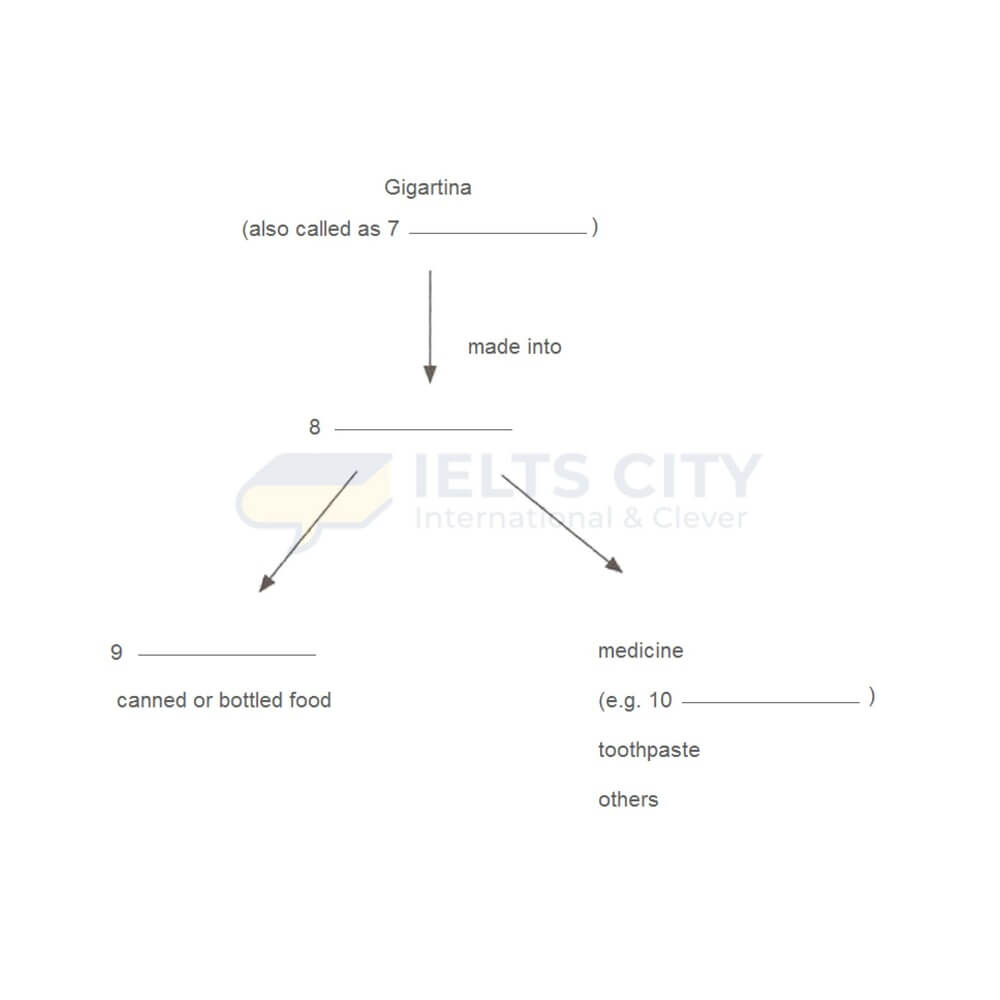
Using the image provided, complete the flowchart below. Choose NO MORE THAN THREE WORDS AND/OR A NUMBER from the passage for each answer.
Questions 11-13
Classify the following characteristics as belonging to:
A. brown seaweed
B. green seaweed
C. red seaweed
- can survive the heat and dryness at the high-water mark
- grow far out in the open sea
- share their site with karengo seaweed
Đáp án kèm phân tích
Questions 1-6: Matching headings
- 1. Paragraph A: ii
- Giải thích: Đoạn A tập trung vào giá trị dinh dưỡng của rong biển, đề cập đến các khoáng chất, vitamin và lợi ích sức khỏe như ngăn ngừa bướu cổ nhờ hàm lượng iốt cao.
- Heading: The nutritional value of seaweeds (Giá trị dinh dưỡng của rong biển).
- 2. Paragraph B: viii
- Giải thích: Đoạn B liệt kê các loài rong biển và ứng dụng thương mại đa dạng của chúng như sản xuất seameal, đồ hộp, sơn, thuốc ho, mỹ phẩm và kem đánh răng.
- Heading: The range of seaweed products (Sự đa dạng các sản phẩm từ rong biển).
- 3. Paragraph C: v
- Giải thích: Đoạn C nói rằng mặc dù New Zealand có nhiều loài rong biển đỏ có giá trị thương mại, nhưng chúng không được tận dụng nhiều cho đến vài thập kỷ trước, thay vào đó là nhập khẩu.
- Heading: The under-use of native seaweeds (Sự chưa tận dụng hết các loại rong biển bản địa).
- 4. Paragraph D: i
- Giải thích: Đoạn D mô tả sự phân loại rong biển theo màu sắc (đỏ, nâu, xanh), vị trí sinh trưởng cụ thể (vùng nước nông, trung bình, sâu) và đặc điểm nhận dạng của chúng.
- Heading: The appearance and location of different seaweeds (Hình dáng và vị trí của các loại rong biển khác nhau).
- 5. Paragraph E: iii
- Giải thích: Đoạn E giải thích cách rong biển sinh sản (bào tử, thụ tinh) và cấu trúc sinh học (không rễ, không hoa, hấp thụ dinh dưỡng qua lá).
- Heading: How seaweeds reproduce and grow (Cách rong biển sinh sản và phát triển).
- 6. Paragraph F: ix
- Giải thích: Đoạn F mô tả các cơ chế giúp rong biển nổi (túi khí) và giữ ẩm để không bị khô khi tiếp xúc với không khí (thân phồng chứa nước, lớp chất nhầy).
- Heading: Why seaweeds don’t sink or dry out (Tại sao rong biển không chìm hoặc bị khô).
Questions 7-10: Flowchart Completion
- 7. New Zealand carrageens
- Giải thích: Đoạn B nói rằng Gigartina thường được gọi là “New Zealand carrageens”.
- 8. agar
- Giải thích: Đoạn B cho biết chất được gọi là “agar” có thể được chiết xuất từ các loài này.
- 9. seameal
- Giải thích: Từ agar, người ta sản xuất ra “seameal”, từ đó làm ra món “seameal custard” (một sản phẩm thực phẩm) và dùng trong công nghiệp đồ hộp.
- 10. cough mixtures
- Giải thích: Agar cũng được dùng trong sản xuất “cough mixtures” (thuốc ho), mỹ phẩm, bánh kẹo và kem đánh răng.
Questions 11-13
- 11. B (green seaweed)
- Giải thích: Đoạn D nói rằng rong biển xanh chủ yếu là tảo vùng nước nông, và những loài nước nông có khả năng chịu đựng việc phơi nắng và không khí lâu dài thường được tìm thấy ở bờ trên (“upper shore” tương ứng với “high-water mark”).
- 12. C (red seaweed)
- Giải thích: Đoạn D xác định rong biển đỏ là thực vật của vùng nước sâu hơn, “furthest from the shore” (xa bờ nhất), tương ứng với “grow far out in the open sea”.
- 13. A (brown seaweed)
- Giải thích: Đoạn D nói rằng bề mặt đá phẳng gần thủy triều trung bình là nơi sống phổ biến của hầu hết rong biển nâu, và đây cũng là nơi sinh sống của “Maori karengo”.
Chúc các bạn luyện thi IELTS Reading hiệu quả và sớm đạt Target nhé!
Cập nhật đề thật sớm nhất tại: