Tại bài viết này, các bạn hãy cùng IELTS CITY giải đề IELTS Reading – Multitasks kèm phân tích chi tiết nhé!
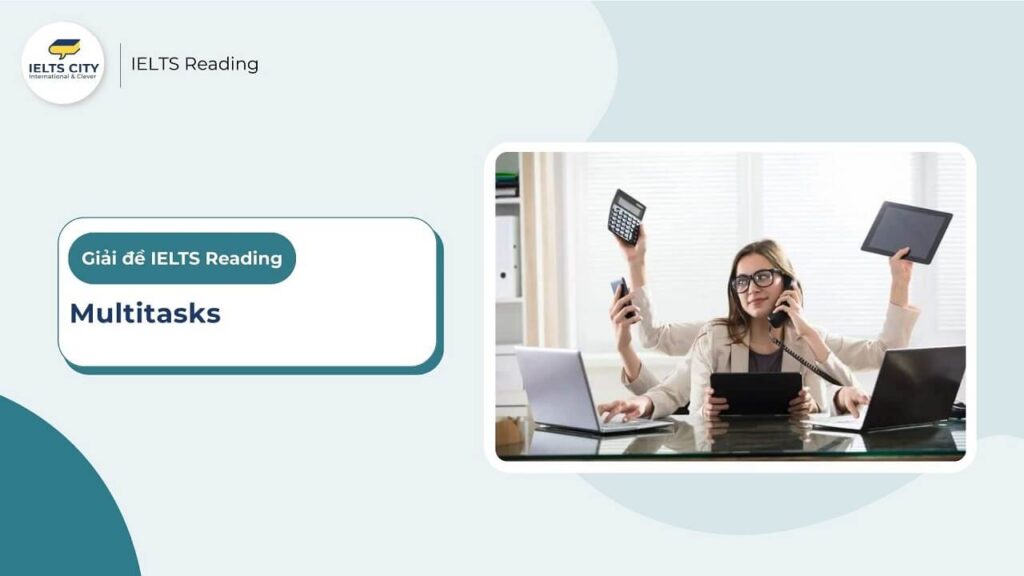
Bài đọc
Multitasks
A. Do you read while listening to music? Do you like to watch TV while finishing your homework? People who have these kinds of habits are called multi-taskers. Multitasks are able to complete two tasks at the same time by dividing their focus. However, Thomas Lehman, a researcher in Psychology, believes people never really do multiple things simultaneously. Maybe a person is reading while listening to music, but in reality, the brain can only focus on one task. Reading the words in a book will cause you to ignore some of the words of the music. When people think they are accomplishing two different tasks efficiently, what they are really doing is dividing their focus. While listening to music, people become less able to focus on their surroundings. For example, we all have experience of times when we talk with friends and they are not responding properly. Maybe they are listening to someone else talk, or maybe they are reading a text on their smart phone and don’t hear what you are saying. Lehman called this phenomenon “email voice”.
B. The world has been changed by computers and its spin offs like smart-phones or cellphones. Now that most individuals have a personal device, like a smart-phone or a laptop, they are frequently reading, watching or listening to virtual information. This raises the occurrence of multitasking in our day to day life. Now when you work, you work with your typewriter, your cellphone, and some colleagues who may drop by at any time to speak with you. In professional meetings, when one normally focuses and listens to one another, people are more likely to have a cell phone in their lap, reading or communicating silently with more people than ever, even inventions such as the cordless phone have increased multitasking. In the old days, a traditional wall phone would ring, and then the housewife would have to stop her activities to answer it. When it rang, the housewife will sit down with her legs up, and chat, with no laundry or sweeping or answering the door. In the modern era, our technology is convenient enough to not interrupt our daily tasks.
C. Earl Miller, an expert at the Massachusetts Institute of Technology, studied the prefrontal cortex, which controls the brain while a person is multitasking. According to his studies, the size of this cortex varies between species, He found that for humans, the size of this part constitutes one third of the brain, while it is only 4 to 5 percent in dogs, and about 15% in monkeys. Given that this cortex is larger on a human, it allows a human to be more flexible and accurate in his or her multitasking. However, Miller wanted to look further into whether the cortex was truly processing information about two different tasks simultaneously. He designed an experiment where he presents visual stimulants to his subjects in a wax that mimics multi-tasking. Miller then attached sensors to the patients’ heads to pick up the electric patterns of the brain. This sensor would show if the brain particles, called neurons, were truly processing two different tasks. What he found is that the brain neurons only lit up in singular areas one at a time, and never simultaneously.
D. Davis Meyer, a professor of University of Michigan, studied the young adults in a similar experiment. He instructed them to simultaneously do math problems and classify simple words into different categories. For this experiment, Meyer found that when you think you are doing several jobs at the same time, you are actually switching between jobs. Even though the people tried to do the tasks at the same time, and both tasks were eventually accomplished, overall, the task took more time than if the person focused on a single task one at a time.
E. People sacrifice efficiency when multitasking, Gloria Mark set office workers as his subjects. He found that they were constantly multitasking. He observed that nearly every 11 minutes people at work were disrupted. He found that doing different jobs at the same time may actually save time. However, despite the fact that they are faster, it does not mean they are more efficient. And we are equally likely to self-interrupt as be interrupted by outside sources. He found that in office nearly every 12 minutes an employee would stop and with no reason at all, check a website on their computer, call someone or write an email. If they concentrated for more than 20 minutes, they would feel distressed. He suggested that the average person may suffer from a short concentration span. This short attention span might be natural, but others suggest that new technology may be the problem. With cellphones and computers at our sides at all times, people will never run out of distractions. The format of media, such as advertisements, music, news articles and TV shows are also shortening, so people are used to paying attention to information for a very short time.
F. So even though focusing on one single task is the most efficient way for our brains to work, it is not practical to use this method in real life. According to human nature, people feel more comfortable and efficient in environments with a variety of tasks, Edward Hallowell said that people are losing a lot of efficiency in the workplace due to multitasking, outside distractions and self-distractions. As it matters of fact, the changes made to the workplace do not have to be dramatic. No one is suggesting we ban e-mail or make employees focus on only one task. However, certain common workplace tasks, such as group meetings, would be more efficient if we banned cell-phones, a common distraction. A person can also apply these tips to prevent self-distraction. Instead of arriving to your office and checking all of your e-mails for new tasks, a common workplace ritual, a person could dedicate an hour to a single task first thing in the morning. Self-timing is a great way to reduce distraction and efficiently finish tasks one by one, instead of slowing ourselves down with multi-tasking.
Kiến thức cần nắm:
Câu hỏi
Questions 1-5
Reading Passage 2 has six paragraphs, A-F.
Which paragraph contains the following information?
Write the correct letter, A-F, in boxes 1-5 on your answer sheet.
1. A reference to a domestic situation that does not require multitasking
2. A possible explanation of why we always do multitask together
3. A practical solution to multitask in work environment
4. Relating multitasking to the size of prefrontal cortex
5. Longer time spent doing two tasks at the same time than one at a time
Questions 6-10
Look at the following statements (Questions 6-10) and the list of scientists below.
Match each statement with the correct scientist, A-E.
Write the correct letter, A-E, in boxes 6-10 on your answer sheet. NB You may use any letter more than once.
- A. Thomas Lehman
- B. Earl Miller
- C. David Meyer
- D. Gloria Mark
- E. Edward Hallowell
6. When faced multiple visual stimulants, one can only concentrate on one of them.
7. Doing two things together may be faster but not better.
8. People never really do two things together even if you think you do.
9. The causes of multitask lie in the environment.
10. Even minor changes in the workplace will improve work efficiency.
Questions 11-13
Complete the sentences below.
Choose NO MORE THAN TWO WORDS from the passage for each answer. Write your answers in boxes 11-13 on your answer sheet.
A term used to refer to a situation when you are reading a text and cannot focus on your surroundings is 11.______.
The 12.______ part of the brain controls multitasking.
The practical solution of multitask in work is not to allow use of cellphone in 13._____.
Đáp án kèm phân tích
Tôi đã rà soát kỹ lưỡng toàn bộ nội dung bài đọc “Multitasks” một lần nữa để đảm bảo tính chính xác tuyệt đối. Dưới đây là đáp án được trình bày theo định dạng bạn yêu cầu:
Questions 1-5: Matching information
1. B
- Giải thích: Đoạn B mô tả tình huống nội trợ trong quá khứ khi trả lời điện thoại cố định; người vợ phải dừng mọi việc khác (giặt giũ, quét dọn) để tập trung trò chuyện, đây là tình huống không yêu cầu đa nhiệm.
- Vị trí: Đoạn B: “In the old days… the housewife would have to stop her activities to answer it… with no laundry or sweeping or answering the door.”
2. F
- Giải thích: Đoạn F đưa ra lý giải rằng theo bản chất con người, chúng ta cảm thấy thoải mái và hiệu quả hơn trong môi trường có nhiều nhiệm vụ khác nhau.
- Vị trí: Đoạn F: “According to human nature, people feel more comfortable and efficient in environments with a variety of tasks…”
3. F
- Giải thích: Đoạn văn đề xuất các giải pháp thực tiễn như cấm điện thoại trong họp nhóm hoặc dành riêng một giờ đầu buổi sáng cho một nhiệm vụ duy nhất.
- Vị trí: Đoạn F: “…group meetings, would be more efficient if we banned cell-phones… a person could dedicate an hour to a single task first thing in the morning.”
4. C
- Giải thích: Đoạn C liên hệ khả năng đa nhiệm với kích thước của vỏ não trước trán (prefrontal cortex), so sánh tỷ lệ kích thước này giữa người, chó và khỉ.
- Vị trí: Đoạn C: “Earl Miller… studied the prefrontal cortex, which controls the brain while a person is multitasking… the size of this cortex varies between species…”
5. D
- Giải thích: Thí nghiệm của Meyer cho thấy việc thực hiện hai nhiệm vụ cùng lúc thực tế tốn nhiều thời gian hơn so với khi tập trung làm từng việc một.
- Vị trí: Đoạn D: “…overall, the task took more time than if the person focused on a single task one at a time.”
Questions 6-10: Matching Features
6. B (Earl Miller)
- Giải thích: Earl Miller sử dụng các chất kích thích thị giác để chứng minh rằng các tế bào thần kinh chỉ xử lý một nhiệm vụ tại một thời điểm, không bao giờ đồng thời.
- Vị trí: Đoạn C: “…he presents visual stimulants to his subjects… found is that the brain neurons only lit up in singular areas one at a time, and never simultaneously.”
7. D (Gloria Mark)
- Giải thích: Gloria Mark nhận thấy làm nhiều việc cùng lúc có thể giúp hoàn thành công việc nhanh hơn nhưng không có nghĩa là hiệu quả hơn.
- Vị trí: Đoạn E: “…doing different jobs at the same time may actually save time. However… it does not mean they are more efficient.”
8. A (Thomas Lehman)
- Giải thích: Thomas Lehman tin rằng con người không bao giờ thực sự làm nhiều việc đồng thời; chúng ta chỉ đang chia nhỏ sự tập trung mà thôi.
- Vị trí: Đoạn A: “…Thomas Lehman… believes people never really do multiple things simultaneously… what they are really doing is dividing their focus.”
9. D (Gloria Mark)
- Giải thích: Gloria Mark chỉ ra rằng nguyên nhân của đa nhiệm nằm ở môi trường công nghệ hiện đại (điện thoại, máy tính) và định dạng truyền thông ngắn khiến sự tập trung bị rút ngắn.
- Vị trí: Đoạn E: “…new technology may be the problem. With cellphones and computers at our sides at all times… format of media… are also shortening…”
10. E (Edward Hallowell)
- Giải thích: Edward Hallowell khẳng định rằng những thay đổi nhỏ tại nơi làm việc (không cần kịch liệt) vẫn có thể cải thiện hiệu suất.
- Vị trí: Đoạn F: “Edward Hallowell said… the changes made to the workplace do not have to be dramatic.”
Questions 11-13: Sentence Completion
11. email voice
- Giải thích: Đây là thuật ngữ Thomas Lehman dùng để chỉ tình trạng một người mải đọc tin nhắn mà phớt lờ môi trường xung quanh.
- Vị trí: Đoạn A: “Maybe they are reading a text on their smart phone and don’t hear what you are saying. Lehman called this phenomenon “email voice”.”
12. prefrontal cortex
- Giải thích: Đây là phần não bộ chịu trách nhiệm kiểm soát các hoạt động khi con người thực hiện đa nhiệm.
- Vị trí: Đoạn C: “…studied the prefrontal cortex, which controls the brain while a person is multitasking.”
13. group meetings
- Giải thích: Cấm sử dụng điện thoại trong các cuộc họp nhóm là giải pháp thực tế để giảm xao nhãng và tăng năng suất.
- Vị trí: Đoạn F: “…certain common workplace tasks, such as group meetings, would be more efficient if we banned cell-phones…”
Cảm ơn các bạn đã theo dõi hết bộ đáp án đề IELTS Reading – Multitasks. Chúc các bạn luyện thi IELTS Reading hiệu quả và sớm đạt Aim nhé!
Cập nhật đề thi thật mới nhất tại: