
Tại bài viết này, IELTS CITY mời các bạn cùng giải đề IELTS Reading – How Deserts are Formed kèm phân tích chi tiết sau đây nhé.
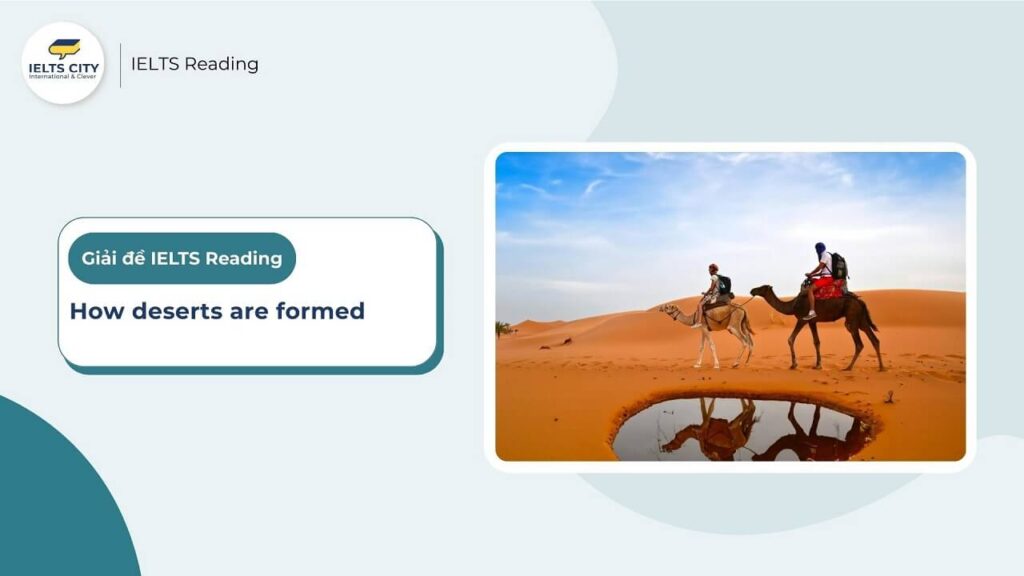
Bài đọc
How Deserts Are Formed
A. A desert refers to a barren section of land, mainly in arid and semi-arid areas, where there is almost no precipitation, and the environment is hostile for any creature to inhabit. Deserts have been classified in a number of ways, generally combining total precipitation, how many days the rainfall occurs, temperature, humidity, and sometimes additional factors. In some places, deserts have clear boundaries marked by rivers, mountains or other landforms, while in other places, there are no clear-cut borders between deserts and other landscape features.
B. In arid areas where there is not any covering of vegetation protecting the land, sand and dust storms will frequently take place. This phenomenon often occurs along the desert margins instead of within the deserts, where there are already no finer materials left. When a steady wind starts to blow, fine particles on the open ground will begin vibrating. As the wind picks up, some of the particles are lifted into the air. When they fall onto the ground, they hit other particles which will then be jerked into the air in their turn, initiating a chain reaction.
C. There has been a tremendous deal of publicity on how severe desertification can be, but the academic circle has never agreed on the causes of desertification. A common misunderstanding is that a shortage of precipitation causes desertification—even the land in some barren areas will soon recover after the rain falls. In fact, more often than not, human activities are responsible for desertification. It might be true that the explosion in world population, especially in developing countries, is the primary cause of soil degradation and desertification. Since the population has become denser, the cultivation of crops has gone into progressively drier areas. It’s especially possible for these regions to go through periods of severe drought, which explains why crop failures are common. The raising of most crops requires the natural vegetation cover to be removed first; when crop failures occur, extensive tracts of land are devoid of a plant cover and thus susceptible to wind and water erosion. All through the 1990s, dryland areas went through a population growth of 18.5 per cent, mostly in severely impoverished developing countries.
D. Livestock farming in semi-arid areas accelerates the erosion of soil and becomes one of the reasons for advancing desertification. In such areas where the vegetation is dominated by grasses, the breeding of livestock is a major economic activity. Grasses are necessary for anchoring barren topsoil in a dryland area. When a specific field is used to graze an excessive herd, it will experience a loss in vegetation coverage, and the soil will be trampled as well as pulverised, leaving the topsoil exposed to destructive erosion elements such as winds and unexpected thunderstorms. For centuries, nomads have grazed their flocks and herds to any place where pasture can be found, and oases have offered chances for a more settled way of living. For some nomads, wherever they move to, the desert follows.
E. Trees are of great importance when it comes to maintaining topsoil and slowing down the wind speed. In many Asian countries, firewood is the chief fuel used for cooking and heating, which has caused uncontrolled clear-cutting of forests in dryland ecosystems. When too many trees are cut down, windstorms and dust storms tend to occur.
F. What’s worse, even political conflicts and wars can also contribute to desertification. To escape from the invading enemies, the refugees will move altogether into some of the most vulnerable ecosystems on the planet. They bring along their cultivation traditions, which might not be the right kind of practice for their new settlement.
G. In the 20th century, one of the states of America had a large section of farmland that had turned into desert. Since then, actions have been enforced so that such a phenomenon of desertification will not happen again. To avoid the reoccurring of desertification, people shall find other livelihoods which do not rely on traditional land uses, are not as demanding on local land and natural resource, but can still generate viable income. Such livelihoods include but are not limited to dryland aquaculture for the raising of fish, crustaceans and industrial compounds derived from microalgae, greenhouse agriculture, and activities that are related to tourism. Another way to prevent the reoccurring of desertification is to bring about economic prospects in the city centres of drylands and places outside of drylands. Changing the general economic and institutional structures that generate new chances for people to support themselves would alleviate the current pressures accompanying the desertification processes.
H. In nowadays society, new technologies are serving as a method to resolve the problems brought by desertification. Satellites have been utilised to investigate the influence that people and livestock have on our planet Earth. Nevertheless, it doesn’t mean that alternative technologies are not needed to help with the problems and process of desertification.
Kiến thức cần nắm:
Câu hỏi
Questions 14 – 20
Reading Passage 2 has eight paragraphs, A-H.
Which paragraph contains the following information?
Write the correct letter, A-H, in boxes 14-20 on your answer sheet.
NB You may use any letter more than once.
14. a reference to the irregular movement of particles
15. mention of a productive land turning into a desert in the 20th century
16. types of deserts
17. mention of technical methods used to tackle the problems of deserts
18. the influence of migration on desertification
19. lack of agreement among the scientists about the causes of desertification
20. a description of the fatal effects of farming practice
Questions 21 – 26
Do the following statements agree with the information given in Reading Passage 2?
In boxes 21-26 on your answer sheet, write
TRUE if the statement is true
FALSE if the statement is false
NOT GIVEN if the information is not given in the passage
21. It is difficult to ascertain where the deserts end in some areas.
22. Media is uninterested in the problems of desertification.
23. The most common cause of desertification is the lack of rainfall.
24. Farming animals in semi-arid areas will increase soil erosion.
25. People in Asian countries no longer use firewood as the chief fuel.
26. Technology studying the relationship of people, livestock and desertification has not yet been invented.
Đáp án kèm phân tích
Questions 14 – 20: Matching Information
14. B
- Giải thích: Đoạn văn mô tả chi tiết sự chuyển động của các hạt bụi và cát khi có gió thổi: các hạt bắt đầu rung động, được nhấc lên không trung, sau đó rơi xuống và va chạm vào các hạt khác tạo thành một phản ứng dây chuyền. Đây là sự mô tả về “chuyển động không đều của các hạt” (irregular movement of particles).
- Vị trí: Đoạn B: “When a steady wind starts to blow, fine particles on the open ground will begin vibrating… initiating a chain reaction.”
15. G
- Giải thích: Đoạn văn đề cập đến một sự kiện lịch sử cụ thể vào thế kỷ 20 tại Mỹ, nơi một diện tích lớn đất nông nghiệp màu mỡ đã biến thành sa mạc.
- Vị trí: Đoạn G: “In the 20th century, one of the states of America had a large section of farmland that had turned into desert.”
16. A
- Giải thích: Đoạn văn đề cập đến việc sa mạc được phân loại theo nhiều cách khác nhau dựa trên các yếu tố như lượng mưa, nhiệt độ, độ ẩm và các yếu tố bổ sung khác. Việc phân loại này tương ứng với khái niệm về các “loại sa mạc” (types of deserts).
- Vị trí: Đoạn A: “Deserts have been classified in a number of ways, generally combining total precipitation… temperature, humidity…”
17. H
- Giải thích: Đoạn văn nhắc đến việc sử dụng các công nghệ mới để giải quyết các vấn đề do sa mạc hóa mang lại. Cụ thể là việc sử dụng vệ tinh để điều tra tác động của con người và gia súc.
- Vị trí: Đoạn H: “In nowadays society, new technologies are serving as a method to resolve the problems… Satellites have been utilised to investigate…”
18. F
- Giải thích: Đoạn văn giải thích về ảnh hưởng của việc di cư cưỡng bức do chiến tranh; những người tị nạn di chuyển đồng loạt vào các hệ sinh thái mỏng manh nhất, mang theo các tập quán canh tác không phù hợp, gây ra sa mạc hóa.
- Vị trí: Đoạn F: “To escape from the invading enemies, the refugees will move altogether into some of the most vulnerable ecosystems… which might not be the right kind of practice…”
19. C
- Giải thích: Đoạn văn chỉ ra rằng mặc dù sa mạc hóa là vấn đề nghiêm trọng được công khai rộng rãi, nhưng giới học thuật vẫn chưa bao giờ đạt được sự thống nhất về các nguyên nhân gây ra nó.
- Vị trí: Đoạn C: “…but the academic circle has never agreed on the causes of desertification.”
20. C
- Giải thích: Đoạn văn mô tả tác động thảm khốc của việc canh tác cây trồng không hợp lý (xóa bỏ lớp phủ thực vật tự nhiên, canh tác ở vùng quá khô hạn) dẫn đến thất bát mùa màng và xói mòn đất nghiêm trọng.
- Vị trí: Đoạn C: “…when crop failures occur, extensive tracts of land are devoid of a plant cover and thus susceptible to wind and water erosion.”
Questions 21 – 26: TRUE / FALSE / NOT GIVEN
21. TRUE
- Giải thích: Tác giả xác nhận rằng ở một số khu vực, không có ranh giới rõ ràng giữa sa mạc và các đặc điểm cảnh quan khác, khiến việc xác định nơi kết thúc của sa mạc là rất khó khăn.
- Vị trí: Đoạn A: “…while in other places, there are no clear-cut borders between deserts and other landscape features.”
22. FALSE
- Giải thích: Câu hỏi cho rằng truyền thông không quan tâm, nhưng bài đọc khẳng định vấn đề này đã nhận được “một lượng lớn sự công khai” (tremendous deal of publicity) về mức độ nghiêm trọng.
- Vị trí: Đoạn C: “There has been a tremendous deal of publicity on how severe desertification can be…”
23. FALSE
- Giải thích: Bài đọc chỉ ra rằng quan điểm cho rằng thiếu mưa gây ra sa mạc hóa là một “hiểu lầm phổ biến” (common misunderstanding); thực tế các hoạt động của con người mới thường xuyên là nguyên nhân chính.
- Vị trí: Đoạn C: “A common misunderstanding is that a shortage of precipitation causes desertification… In fact, more often than not, human activities are responsible…”
24. TRUE
- Giải thích: Việc chăn nuôi gia súc ở các vùng bán khô hạn làm mất lớp phủ thực vật, gia súc giẫm đạp và phá vỡ cấu trúc đất, trực tiếp dẫn đến việc đẩy nhanh quá trình xói mòn đất.
- Vị trí: Đoạn D: “Livestock farming in semi-arid areas accelerates the erosion of soil… experiencing a loss in vegetation coverage, and the soil will be trampled as well as pulverised…”
25. FALSE
- Giải thích: Bài đọc cho biết củi “là” nhiên liệu chính được sử dụng ở nhiều nước châu Á, điều này có nghĩa là hiện tại họ vẫn đang sử dụng.
- Vị trí: Đoạn E: “In many Asian countries, firewood is the chief fuel used for cooking and heating…”
26. FALSE
- Giải thích: Bài đọc khẳng định rằng công nghệ (vệ tinh) đã được sử dụng để nghiên cứu mối quan hệ giữa con người, gia súc và tác động của chúng lên Trái Đất.
- Vị trí: Đoạn H: “Satellites have been utilised to investigate the influence that people and livestock have on our planet Earth.”
Cảm ơn các bạn đã theo dõi hết đáp án đề IELTS Reading – How Deserts are Formed kèm phân tích chi tiết của IELTS CITY. Chúc các bạn luyện thi IELTS Reading hiệu quả và sớm đạt Aim nhé!
Cập nhật đề thi thật sớm nhất tại: