
Tại bài viết này, IELTS CITY sẽ cùng các bạn giải đề thi thật IELTS Reading – Dust and the America West kèm phân tích chi tiết sau đây nhé!
Bài đọc
Dust and the America West
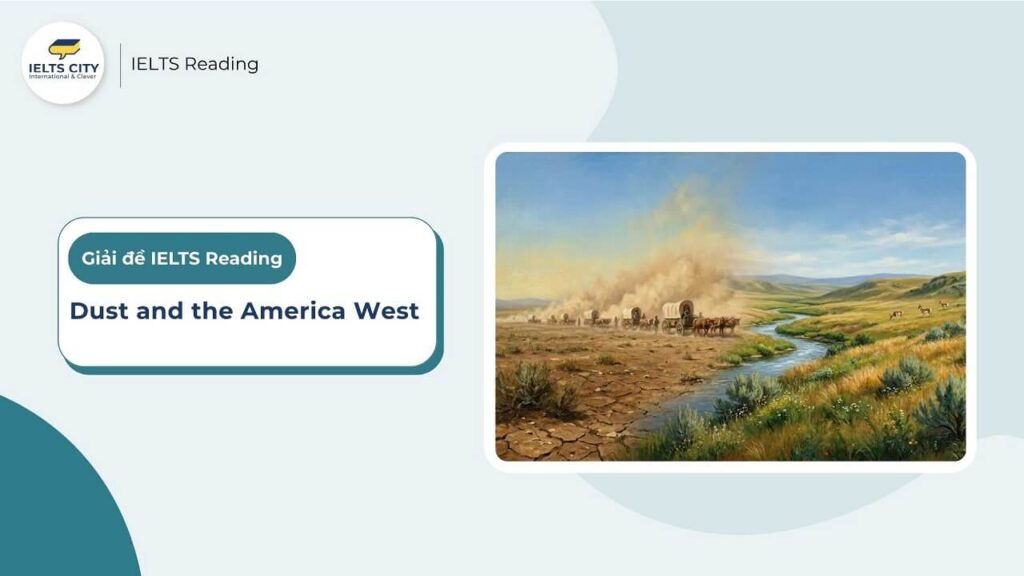
Images of deserts in the United States show dusty, barren landscapes, but the land may not always have been this way. Ever since settlers moved west across the US there have been dust-clouds of it everywhere. It was part of the landscape, or so it seemed to them. But there were no records of the landscape of the West until the settlers arrived. Now evidence is starting to emerge which suggests that before the settlers, there was very little dust.
The evidence comes from the San Juan mountains of southwest Colorado, downwind of Arizona and New Mexico. There Jason Neff, a geochemist from the University of Colorado, has been analyzing sediments, the sand, stones and mud, laid down over the past 5000 years. Atmospheric dust was minimal throughout those five millennia until the mid-19th century, he says, but then, ‘from about 1860 to 1900, dust deposition rates shot up.’
This is surprising because usually dry means dusty, and the American West has almost always been dry-often drier than today. There was a near-permanent drought between 900 and 1300 which was so intense that it destroyed a series of native American civilizations, including the Anasazi, whose cliff homes are now national treasures. Yet the evidence from the San Juan lakes is that it was not dusty. Even as their civilization was collapsing, the Anasazi seem to have protected their soils from erosion.
This was not the case with the European settlers once they brought their cows. The landscape the cattle were introduced to was remarkably ill-equipped to cope with grazing animals, says Neff. ‘Unlike most other parts of the US, there were few grazers in the American Southwest until the Europeans came. No bison and few antelope or deer.’
In the Great Plains to the east and north, bison roamed in vast herds. Their regular grazing had created tough grass, while the herds manured the soil. In the Southwest, the land had few defenses against a sudden invasion of millions of livestock, whose teeth stripped the grass and whose hooves punctured the hard crust of desert soils that protected them from the wind. The invasion was sudden, funded by a bubble of speculative investment, much of it from Britain. The money went into railroads, and herds of cattle and sheep that rode the rails to the wide open pastures. By 1900, when sedimentation rates peaked, there were 20 million cattle and 25 million sheep in the West.
One of the biggest ranches was owned by the Aztec Land and Cattle Company, which owned a million acres of land by 1884. Each acre had cost the company a mere 50 cents, and like many other speculators, it was only interested in quick profits and had little incentive to protect the land from overgrazing. By the time Aztec sold the ranch in 1901, it was an ecological disaster. The land was stripped bare, and wind erosion had taken hold on a massive scale. This pattern was repeated across the region.
The consequences were severe. The Dust Bowl of the 1930s, which devastated the Great Plains, was partly a product of this earlier degradation combined with drought and poor farming practices. The legacy of dust continues to affect the region today, influencing air quality, soil fertility, and water availability. Modern conservation efforts aim to restore damaged grasslands and implement sustainable grazing practices, but the evidence from the San Juan sediments serves as a stark reminder of how quickly human activity can transform a landscape and create an environmental legacy that lasts for centuries.
Kiến thức cần nắm:
Câu hỏi
Questions 1 – 5
Complete the summary below. Choose NO MORE THAN TWO WORDS AND/OR A NUMBER from the passage for each answer.
Research in the 1 ________ mountains shows that dust levels were low for 5000 years until the mid-19th century. This is surprising because the region experienced a severe 2 ________ from 900 to 1300, yet remained relatively dust-free. The increase in dust is linked to the arrival of 3 ________ settlers and their livestock. Unlike the 4 ________ that had grazed the Great Plains, the Southwestern landscape was not adapted to heavy grazing. By 1900, there were millions of cattle and sheep, funded largely by 5 ________ investment.
Questions 6 – 10
Do the following statements agree with the information given in Reading Passage 1? Write:
TRUE if the statement agrees with the information
FALSE if the statement contradicts the information
NOT GIVEN if there is no information on this
6. Written records of the Western landscape exist from before European settlement.
7. The Anasazi civilization collapsed primarily due to dust storms.
8. Bison were common in the American Southwest before European arrival.
9. The Aztec Land and Cattle Company was focused on long-term land conservation.
10. The Dust Bowl of the 1930s was an unrelated event to earlier overgrazing.
Questions 11 – 13
Choose the correct letter, A, B, C, or D.
11. What is the main finding of Jason Neff’s sediment analysis?
A. Dust levels have always been high in the American West.
B. A significant increase in dust began around the time of European settlement.
C. The Anasazi caused the first major increase in dust.
D. Dust levels peaked during the medieval drought.
12. According to the passage, why was the Southwestern landscape vulnerable to grazing animals?
A. It had very soft soil.
B. It lacked a history of large grazing herds.
C. It was too wet for grass to grow.
D. Native Americans had already overgrazed it.
13. What is the main purpose of the final paragraph?
A. To predict future dust levels in the West.
B. To describe the benefits of speculative investment.
C. To outline the long-term consequences and modern relevance of the dust increase.
D. To argue that the Dust Bowl was solely caused by drought.
Đáp án kèm phân tích
Questions 1 – 5: Summary Completion
- San Juan
- Giải thích: Bằng chứng về lượng bụi thấp trong quá khứ được Jason Neff thu thập từ việc phân tích trầm tích tại dãy núi San Juan ở tây nam Colorado.
- Vị trí: Đoạn 2.
- drought
- Giải thích: Mặc dù vùng Tây Nam trải qua một trận hạn hán (drought) cực kỳ nghiêm trọng từ năm 900 đến 1300, dữ liệu cho thấy khu vực này vẫn không có bụi vào thời điểm đó.
- Vị trí: Đoạn 3.
- European
- Giải thích: Sự gia tăng lượng bụi lắng đọng bắt đầu từ giữa thế kỷ 19, trùng khớp với thời điểm những người định cư Châu Âu (European settlers) mang gia súc đến.
- Vị trí: Đoạn 4.
- bison
- Giải thích: Khác với vùng Đại Bình nguyên nơi bò rừng (bison) giúp cỏ và đất trở nên bền bỉ hơn, vùng Tây Nam có rất ít động vật ăn cỏ lớn trước khi người Châu Âu đến.
- Vị trí: Đoạn 4 & 5.
- speculative
- Giải thích: Cuộc “xâm lăng” của gia súc diễn ra đột ngột và được tài trợ bởi các khoản đầu tư mang tính đầu cơ (speculative investment).
- Vị trí: Đoạn 5.
Questions 6 – 10: TRUE / FALSE / NOT GIVEN
- FALSE
- Giải thích: Văn bản khẳng định rõ ràng rằng không có bất kỳ ghi chép nào về phong cảnh miền Tây cho đến khi những người định cư xuất hiện.
- Vị trí: Đoạn 1.
- FALSE
- Giải thích: Nền văn minh Anasazi sụp đổ do hạn hán nghiêm trọng; thực tế là họ đã bảo vệ đất đai rất tốt khỏi sự xói mòn và thời kỳ đó không hề có bụi.
- Vị trí: Đoạn 3.
- FALSE
- Giải thích: Vùng Tây Nam Hoa Kỳ vốn có rất ít động vật ăn cỏ và cụ thể là không có bò rừng (bison) trước khi người Châu Âu mang gia súc đến.
- Vị trí: Đoạn 4.
- FALSE
- Giải thích: Công ty Aztec Land and Cattle chỉ quan tâm đến lợi nhuận nhanh chóng (quick profits) và không có động lực để bảo vệ đất đai khỏi việc chăn thả quá mức.
- Vị trí: Đoạn 6.
- FALSE
- Giải thích: Thảm họa “Dust Bowl” những năm 1930 là kết quả trực tiếp của sự suy thoái đất đai do chăn thả quá mức trước đó kết hợp với hạn hán.
- Vị trí: Đoạn 7.
Questions 11 – 13: Multiple Choice
- B (A significant increase in dust began around the time of European settlement.)
- Giải thích: Phân tích của Neff cho thấy bụi ở mức tối thiểu trong 5000 năm và chỉ bắt đầu tăng vọt từ khoảng năm 1860, khi người định cư bắt đầu khai thác đất đai.
- Vị trí: Đoạn 2.
- B (It lacked a history of large grazing herds.)
- Giải thích: Vùng Tây Nam không có bò rừng như vùng Đại Bình nguyên, nên đất đai và lớp vỏ cứng (soil crust) của nó không có khả năng chống chọi với móng guốc và sự chăn thả của hàng triệu con gia súc.
- Vị trí: Đoạn 4 & 5.
- C (To outline the long-term consequences and modern relevance of the dust increase.)
- Giải thích: Đoạn cuối trình bày về di sản của bụi ảnh hưởng đến hiện tại (chất lượng không khí, nước) và các nỗ lực bảo tồn ngày nay nhằm phục hồi cỏ.
- Vị trí: Đoạn 7.
Vừa rồi, IELTS CITY đã cùng các bạn giải đề thi thật IELTS Reading – Dust and the America West kèm phân tích chi tiết. Chúc các bạn luyện thi IELTS Reading hiệu quả và sớm đạt Aim nhé!
Cập nhật đề thi thật IELTS Reading sớm nhất tại: