Tại bài viết này, IELTS CITY sẽ cùng các bạn giải đề IELTS Reading – Assessing the risk kèm phân tích chi tiết sau đây nhé!
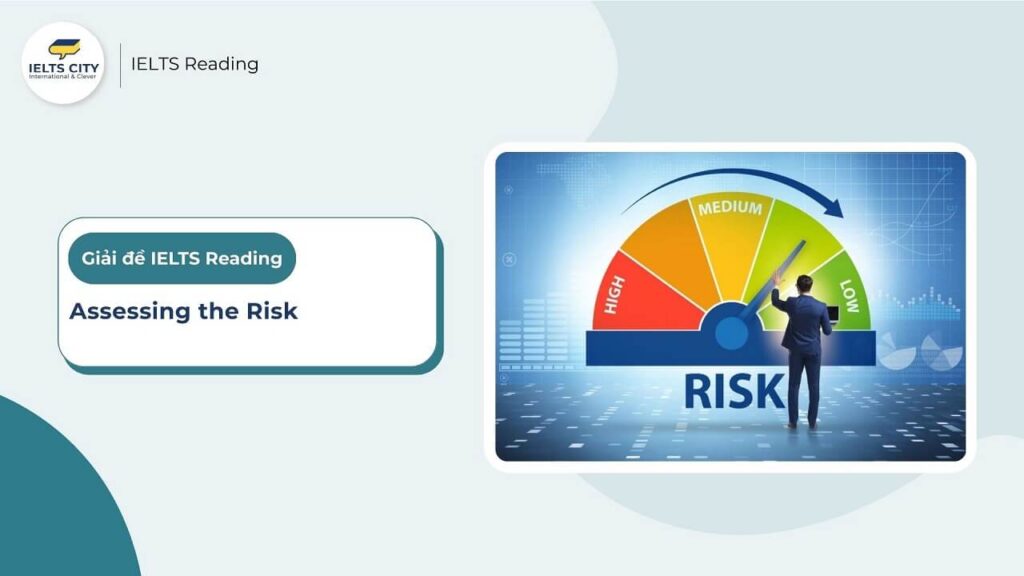
Bài đọc
Assessing the risk
A. As a title for a supposedly unprejudiced debate on scientific progress, “Panic attack: interrogating our obsession with risk” did not bode well. Held last week at the Royal Institution in London, the event brought together scientists from across the world to ask why society is so obsessed with risk and to call for a “more rational” approach. “We seem to be organising society around the grandmotherly maxim of ‘better safe than sorry’,” exclaimed Spiked, the online publication that organised the event. “What are the consequences of this overbearing concern with risks?”
B. The debate was preceded by a survey of 40 scientists who were invited to describe how awful our lives would be if the “precautionary principle” had been allowed to prevail in the past. Their response was: no heart surgery or antibiotics, and hardly any drugs at all; no aeroplanes, bicycles or high-voltage power grids; no pasteurisation, pesticides or biotechnology; no quantum mechanics; no wheel; no “discovery” of America. In short, their message was: no risk, no gain.
C. They have absolutely missed the point. The precautionary principle is a subtle idea. It has various forms, but all of them generally include some notion of cost-effectiveness. Thus the point is not simply to ban things that are not known to be absolutely safe. Rather, it says: “Of course you can make no progress without risk. But if there is no obvious gain from taking the risk, then don’t take it.”
D. Clearly, all the technologies listed by the 40 well-chosen savants were innately risky at their inception, as all technologies are. But all of them would have received the green light under the precautionary principle because they all had the potential to offer tremendous benefits – the solutions to very big problems – if only the snags could be overcome.
E. If the precautionary principle had been in place, the scientists tell us, we would not have antibiotics. But of course, we would – if the version of the principle that sensible people now understand had been applied. When penicillin was discovered in the 1920s, infective bacteria were laying waste to the world. Children died from diphtheria and whooping cough, every open-drain brought the threat of typhoid, and any wound could lead to septicaemia and even gangrene.
F. Penicillin was turned into a practical drug during the Second World War when the many pestilences that result from were threatened to kill more people than the bombs. Of course antibiotics were a priority. Of course, the risks, such as they could be perceived, were worth taking.
G. And so with the other items on the scientists’ list: electric light bulbs, blood transfusions. CAT scans, knives, the measles vaccine – the precautionary principle would have prevented all of them, they tell us. But this is just plain wrong. If the precautionary principle had been applied properly, all these creations would have passed muster, because all offered incomparable advantages compared to the risks perceived at the time.
H. Another issue is at stake here. Statistics are not the only concept people use when weighing up risk. Human beings, subtle and evolved creatures that we are, do not survive to three-score years and ten simply by thinking like pocket calculators. A crucial issue is the consumer’s choice. In deciding whether to pursue the development of new technology, the consumer’s right to choose should be considered alongside considerations of risk and benefit. Clearly, skiing is more dangerous than genetically modified tomatoes. But people who ski choose to do so; they do not have skiing thrust upon them by portentous experts of the kind who now feel they have the right to reconstruct our crops. Even with skiing, there is the matter of cost-effectiveness to consider: skiing, I am told, is exhilarating. Where is the exhilaration in GM soya?
I. Indeed, in contrast to all the other items on Spiked’s list, GM crops stand out as an example of a technology whose benefits are far from clear. Some of the risks can at least be defined. But in the present economic climate, the benefits that might accrue from them seem dubious. Promoters of GM crops believe that the future population of the world cannot be fed without them. That is untrue. The crops that really matter are wheat and rice, and there is no GM research in the pipeline that will seriously affect the yield of either. GM is used to make production cheaper and hence more profitable, which is an extremely questionable ambition.
J. The precautionary principle provides the world with a very important safeguard. If it had been in place in the past it might, for example, have prevented insouciant miners from polluting major rivers with mercury. We have come to a sorry pass when scientists, who should above all be dispassionate scholars, feel they should misrepresent such a principle for the purposes of commercial and political propaganda. People at large continue to mistrust science and the high technologies it produces partly because they doubt the wisdom of scientists. On such evidence as this, these doubts are fully justified.
Kiến thức cần nắm:
Câu hỏi
Questions 1 – 6
Do the following statements agree with the information given in Reading Passage?
In boxes 1-6 on your answer sheet, write
TRUE if the statement is true
FALSE if the statement is false
NOT GIVEN if the information is not given in the passage
1 The title of the debate is not unbiased.
2 All the scientists invited to the debate were from the field of medicine.
3 The message those scientists who conducted the survey were sending was people shouldn’t take risks.
4 All the 40 listed technologies are riskier than other technologies.
5 It was worth taking the risks to invent antibiotics.
6 All the other inventions on the list were also judged by the precautionary principle.
Questions 7 – 13
Complete the following summary of the paragraphs of Reading Passage
Using NO MORE THAN THREE WORDS from the Reading Passage for each answer.
Write your answers in boxes 7-13 on your answer sheet.
When applying the precautionary principle to decide whether to invent a new technology, people should also the consideration of the 7…………… , along with the usual consideration of 8…………… . For example, though risky and dangerous enough, people still enjoy 9…………… for the excitement it provides. On the other hand, experts believe that future population desperately needs 10…………… in spite of their undefined risks. However, the researchers conducted so far have not been directed towards increasing the yield of 11…………… , but to reduce the cost of 12…………… and to bring more profit out of it. In the end, such selfish use of the precautionary principle for business and political gain has often led people to 13…………… science for they believe scientists are not to be trusted.
Question 14
Choose the correct letter, A, B, C or D.
Write your answers in boxes 14 on your answer sheet.
14. What is the main theme of the passage?
A people have the right to doubt science and technologies
B the precautionary principle could have prevented the development of science and technology
C there are not enough people who truly understand the precautionary principle
D the precautionary principle bids us take risks at all costs
Đáp án kèm phân tích
Questions 1 – 6: TRUE / FALSE / NOT GIVEN
1. TRUE
- Giải thích: Tác giả nhận định tiêu đề của buổi tranh luận (“Panic attack: interrogating our obsession with risk”) là một dấu hiệu không tốt cho một cuộc thảo luận lẽ ra phải khách quan (unprejudiced/unbiased).
- Vị trí: Đoạn A: “As a title for a supposedly unprejudiced debate… ‘Panic attack: interrogating our obsession with risk’ did not bode well.”
2. NOT GIVEN
- Giải thích: Bài đọc chỉ nói buổi tranh luận quy tụ “các nhà khoa học từ khắp nơi trên thế giới”. Danh sách các phát minh bao gồm từ y học đến năng lượng và vật lý, nhưng văn bản không khẳng định tất cả họ đều thuộc lĩnh vực y học.
3. FALSE
- Giải thích: Thông điệp của các nhà khoa học trong khảo sát là “không có rủi ro, không có lợi nhuận” (no risk, no gain), tức là họ ủng hộ việc chấp nhận rủi ro để tiến bộ. Câu hỏi nói họ khuyên “không nên chấp nhận rủi ro” là sai.
- Vị trí: Đoạn B: “…their message was: no risk, no gain.”
4. NOT GIVEN
- Giải thích: Tác giả nói 40 công nghệ được liệt kê đều có rủi ro từ lúc mới ra đời như mọi loại công nghệ khác, nhưng không có thông tin so sánh rằng chúng “rủi ro hơn” (riskier than) các loại khác.
5. TRUE
- Giải thích: Tác giả khẳng định rằng trong bối cảnh dịch bệnh nghiêm trọng lúc bấy giờ, rủi ro để phát minh ra thuốc kháng sinh là hoàn toàn đáng giá.
- Vị trí: Đoạn F: “Of course antibiotics were a priority. Of course, the risks… were worth taking.”
6. TRUE
- Giải thích: Tác giả lập luận rằng theo quan điểm của 40 nhà khoa học, tất cả các phát minh trong danh sách đều bị đem ra xem xét/đánh giá (judged) dựa trên nguyên tắc phòng ngừa.
- Vị trí: Đoạn G: “And so with the other items on the scientists’ list… the precautionary principle would have prevented all of them, they tell us.”
Dưới đây là phần trình bày lại chi tiết cho các câu hỏi từ 7 đến 13 của bài đọc “Assessing the Risk” theo đúng format bạn yêu cầu. Tôi đã đối soát kỹ lưỡng để đảm bảo thông tin chính xác tuyệt đối.
Questions 7 – 13: Summary Completion
7. consumer’s right
- Giải thích: Tác giả lập luận rằng bên cạnh các yếu tố rủi ro và lợi ích, quyền lựa chọn của người tiêu dùng là một vấn đề then chốt cần được cân nhắc khi quyết định phát triển công nghệ mới.
- Vị trí: Đoạn H: “In deciding whether to pursue the development of new technology, the consumer’s right to choose should be considered alongside considerations of risk and benefit.”
8. risk and benefit
- Giải thích: Đây là hai khía cạnh thông thường luôn được đặt lên bàn cân so sánh song song với quyền lựa chọn của người mua.
- Vị trí: Đoạn H: “…the consumer’s right to choose should be considered alongside considerations of risk and benefit.”
9. skiing
- Giải thích: Tác giả sử dụng hoạt động trượt tuyết làm ví dụ cho một việc đầy rủi ro nhưng con người vẫn tự nguyện chọn vì nó mang lại cảm giác phấn khích (exhilarating).
- Vị trí: Đoạn H: “Clearly, skiing is more dangerous than genetically modified tomatoes… skiing, I am told, is exhilarating.”
10. GM crops
- Giải thích: Những người ủng hộ công nghệ này tin rằng dân số tương lai sẽ không thể được nuôi sống nếu thiếu sự hỗ trợ của các loại cây trồng biến đổi gen.
- Vị trí: Đoạn I: “Promoters of GM crops believe that the future population of the world cannot be fed without them.”
11. wheat and rice
- Giải thích: Mặc dù đây là hai loại lương thực quan trọng nhất đối với thế giới, nhưng thực tế các nghiên cứu GM hiện nay vẫn chưa giúp tăng năng suất cho chúng.
- Vị trí: Đoạn I: “The crops that really matter are wheat and rice, and there is no GM research in the pipeline that will seriously affect the yield of either.”
12. production
- Giải thích: Thay vì giải quyết các vấn đề lớn của nhân loại, công nghệ GM chủ yếu được áp dụng để cắt giảm chi phí sản xuất nhằm mang lại nhiều lợi nhuận hơn.
- Vị trí: Đoạn I: “GM is used to make production cheaper and hence more profitable…”
13. mistrust
- Giải thích: Việc bóp méo các nguyên tắc khoa học vì mục đích chính trị và thương mại ích kỷ đã khiến công chúng nảy sinh tâm lý mất niềm tin vào khoa học và giới chuyên gia.
- Vị trí: Đoạn J: “People at large continue to mistrust science and the high technologies it produces partly because they doubt the wisdom of scientists.”
Question 14: Multiple choice
14. A
- Giải thích: Chủ đề chính của bài viết xoay quanh việc các nhà khoa học đã xuyên tạc nguyên tắc phòng ngừa để phục vụ lợi ích chính trị/thương mại, và tác giả kết luận rằng sự nghi ngờ của công chúng đối với khoa học là hoàn toàn có cơ sở.
- Vị trí: Đoạn J: “People at large continue to mistrust science… these doubts are fully justified.”.
Cảm ơn các bạn đã theo dõi hết đáp án đề thi IELTS Reading – Assessing the Risk kèm phân tích chi tiết của IELTS CITY. Chúc các bạn luyện thi IELTS Reading hiệu quả và sớm đạt Target nhé!
Cập nhật đề thi thật sớm nhất tại: